
The Complete Guide to Rightsizing & Moving Checklist



The Rightsizing Assessment
Not sure if a move is right for you? Start by taking an honest inventory of your current lifestyle and the home that supports it. Ask yourself these questions to determine whether your current home is working well for you, or whether you would be better off making a change.
Space Utilization
- Which rooms or areas in your home do you use on a daily or weekly basis?
- Which rooms or areas in your home are used less than once a month, or not at all (e.g., formal dining room, basement storage, guest bedroom)?
- Are you storing items in your home that you haven’t touched in years (not counting family heirlooms)?
- Are there spaces in your home that are difficult to use because they are overly cluttered (e.g., a storage space that is bursting or a closet with so many clothes you can't remember everything that might be inside)?
Maintenance
- How much time do you spend each week cleaning and maintaining the interior of your home?
- Do you enjoy tasks like mowing, landscaping, and snow removal, or are these exterior maintenance tasks putting a strain on your time, finances, or physical health?
- After home maintenance tasks are complete, do you have enough time and energy left over for activities that bring you joy (e.g., time with family/friends, shows and concerts, travel)?
Accessibility
- Are you comfortable navigating any stairs in your current home, and do you anticipate that changing in the next 5-10 years?
- Does your home pose any tripping hazards (e.g., narrow or cluttered hallways, high thresholds, differences in elevation)?
- What modifications would you need to make in your current home to remain there long-term (e.g., main-floor laundry access, widened hallways or doorways, zero-entry transitions in flooring and showers)?
Location
- Does your current location provide easy access to the amenities you use most often (e.g., shopping, restaurants, parks, pharmacies, banks, salons)?
- Would you like to live closer to friends or family members?
Finances
- Would lowering housing costs make other financial goals possible (e.g., travel, investments, savings, philanthropic goals)?
- Would having fewer belongings leave clearer guidance for those who will one day settle your affairs?



The Rightsizing Mindset
The decision to rightsize isn't just about changing your address; it's about changing your mindset. When you choose to rightsize, you choose a proactive approach to defining your next chapter.
Consider why you moved into your current home to begin with. Maybe the addition of a new baby or family member necessitated more bedrooms, or maybe you wanted a bigger yard for your dog to enjoy. As our lives evolve, it’s wise to take stock once again of current needs and ask the question: Is it time to move and rightsize my home?
For many, the answer is yes. By rightsizing now, you could:
- Gain more years of enjoying a simplified, low-maintenance lifestyle in a home that better fits your needs.
- Manage the process on your own terms rather than undertaking a move when it’s forced by a health change or other circumstances.
- Take your time researching to find your ideal home in a community you love.
Delaying the decision to move often means that health or time constraints make the transition feel bigger and more stressful. Waiting until the need to move becomes more urgent also can force you to settle for what is immediately available, rather than finding the environment in which you will truly thrive. Rightsizing for seniors isn’t about coming to the end of an era; it’s about investing in your best possible future.



The Decluttering Process
Regardless of whether you’re moving to a smaller space or optimizing your existing one, rightsizing presents the perfect opportunity to sort through possessions and be more purposeful about the things to which you give your time and energy.
Sorting through everything you own can feel overwhelming, but you can replace overwhelm with structure to make steady progress toward your goal.
Four-Box Sorting Method
The four-box method provides an effective approach for decluttering and determining what to do with each item in your home.
Designate four large containers (or landing areas), and as you pick up each item you’re sorting through, determine its future and place it in the corresponding space:
- Keep: These are the select items you will continue to use and enjoy in your new space.
- Sell or Donate: These are good-condition items you no longer need that can be sold, donated, or given to a friend.
- Gift to Family: These are items with sentimental value that no longer have space in your home, but would be treasured by family.
- Toss or Recycle: Anything broken, expired, or unusable can go straight into the trash or recycling bin.
Room-by-Room Attack Plan
Decluttering your whole home can feel formidable until you divide the task into more manageable chunks. Try employing a room-by-room attack plan.
Start small (with a linen closet, for example) to build momentum before tackling larger rooms with more items to sort through. Finish with concentrated storage areas, like the attic, shed, or garage.
Keep in mind that sorting through bins and boxes in storage can be physically demanding, so this task is best shared with family or friends who can do some of the heavy lifting while you direct where items should go.
Documents and Digital Archives
As you organize your possessions, you’ll want to pay special attention to your files, both paper and digital. Begin by disposing of old bills you’ve paid and records that are no longer relevant. Create a secure, organized filing system for essential papers, including estate planning documents and other records. You may want to consider digitizing some documents, along with photos, so you have backups should anything happen to the physical copies. Digitizing also can allow you to dispose of some physical media and lighten your storage load.
.png?width=450&length=450&name=How%20to%20Organize%20and%20Declutter%20for%20a%20Stress-Free%20Space%20(A%20Checklist).png)


Managing Heirlooms and Mementos
Some aspects of decluttering feel easy, such as tossing duplicate kitchen utensils or donating clothes you never wear. Dealing with sentimental items, on the other hand, can feel deeply difficult. Items that invoke fond memories don’t feel like “stuff,” and it’s best to approach these items differently than other items in your home.
Consider these tips to manage sentimental items throughout your home:
Employ a time limit.
Sorting through sentimental items such as photo albums and memorabilia can be enjoyable but also mentally and emotionally taxing, so it’s helpful to work on this task in limited increments. Try setting a timer for 90 minutes, for example, and take a break or move onto a different task when the time is up.
Preserve memories over possessions.
Keeping physical items isn’t the only way to hold onto fond memories. Consider taking photographs of cherished items you no longer want to store and displaying them in a photo album or scrapbook. You also can cut samples of fabric and preserve them in a journal or give them new life in a memory quilt.
Don’t wait to pass on heirlooms.
You can simplify your estate planning and reduce your possessions by taking the opportunity now to pass on heirlooms. Invite input from family members to learn what items are meaningful to them, and which items don’t fit into their homes. This principle not only applies to valuable possessions but also to any items you intend to give away that may hold sentimental value, such as wall hangings, cookie jars, recipe books, and more.
Use the sticker method.
If you’re unsure how to divide items, consider using the sticker method. Give each loved one a sheet of stickers in a particular color, and have them take turns placing their stickers on items they would like to receive. Items that end up with one sticker automatically go to the person who wished to receive them. Then, you can determine a fair way to distribute items that multiple family members would appreciate. This method takes some guesswork out of the process.



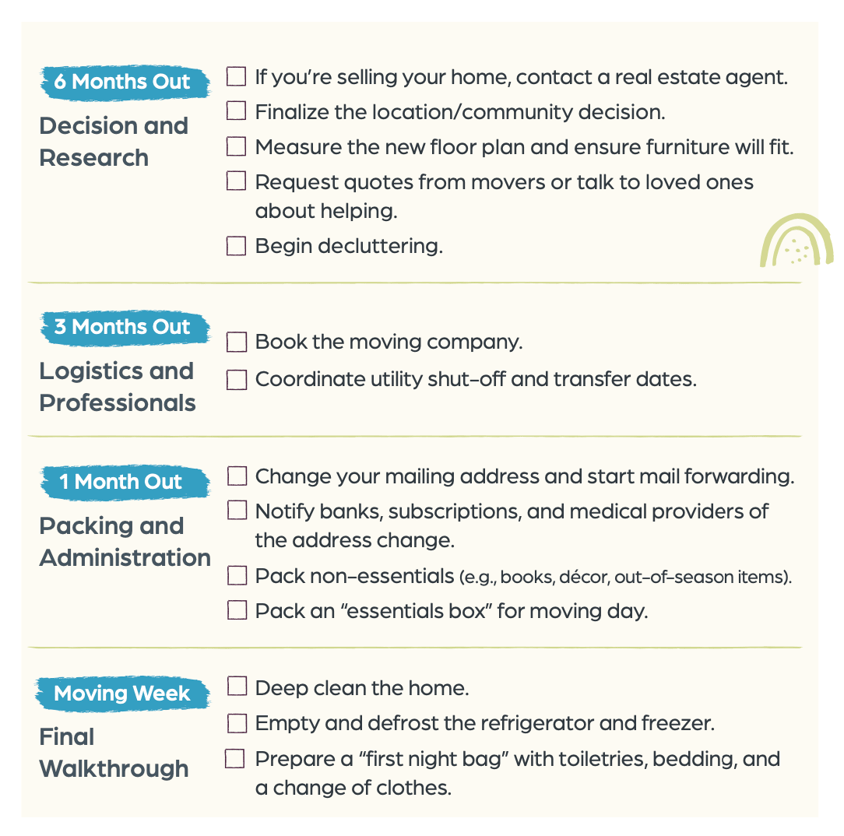
Senior Moving Checklist
(6 Months to Moving Day)
Rightsizing for seniors doesn’t always look the same for everyone, but this checklist provides a starting point to help you consider key areas you’ll want to manage if you’re moving to a new home.

.jpeg?width=2000&name=AdobeStock_307189366%20(1).jpeg)

Making Your New House a Home
The last box is unpacked, the movers are gone, and the quiet settles in. After the effort of rightsizing and moving, it’s time to make your new space feel like home.
Unpacking Thoughtfully
Although you may want to unpack everything at once, you can save some stress and preserve your energy by taking a strategic approach to unpacking. Prioritize the kitchen, bathroom, and bedroom first, as these areas tend to be vital for your comfort and routine. Focusing on these functional spaces first ensures you can eat, sleep, and refresh comfortably before tackling décor and non-essential items. Save the storage closets, guest areas, and sentimental boxes for when your basic routine is established, but consider including one sentimental item, such as a framed photo, in one of your essential boxes so you can enjoy a personal touch from day one in your new home.
Finding Your Flow
If you’ve moved to a smaller home, thoughtful design choices can help you cultivate your desired feeling. For instance, darker paint colors, plush furniture, and softer lighting can create a cozy atmosphere. If you want to make a smaller space feel more spacious, opt for lighter colors and invite in more light. You also can use rugs and furniture to designate different living zones and create a flow that feels natural for your lifestyle.
Connecting in Your New Community
A home is only as fulfilling as the community that surrounds it. Once you are settled in, make integration a priority. If you've moved to a new neighborhood, introduce yourself to immediate neighbors. If you’ve moved to a senior living community, attend events and participate in programming to meet peers. Seek out opportunities to make your days exactly what you would like them to be. Maybe that includes joining a book club or attending an exercise class, or maybe it means meeting up with friends for a good meal and a game of cards. It’s all up to you!
Ready to rightsize your life? Rightsizing doesn’t just make your life simpler; it makes it more fulfilling and more “you” than ever before. Take the first step today toward freedom and fulfillment.