
When uncertainty spread across communities in the early days of COVID-19, many people paused, waiting to see what would come next.
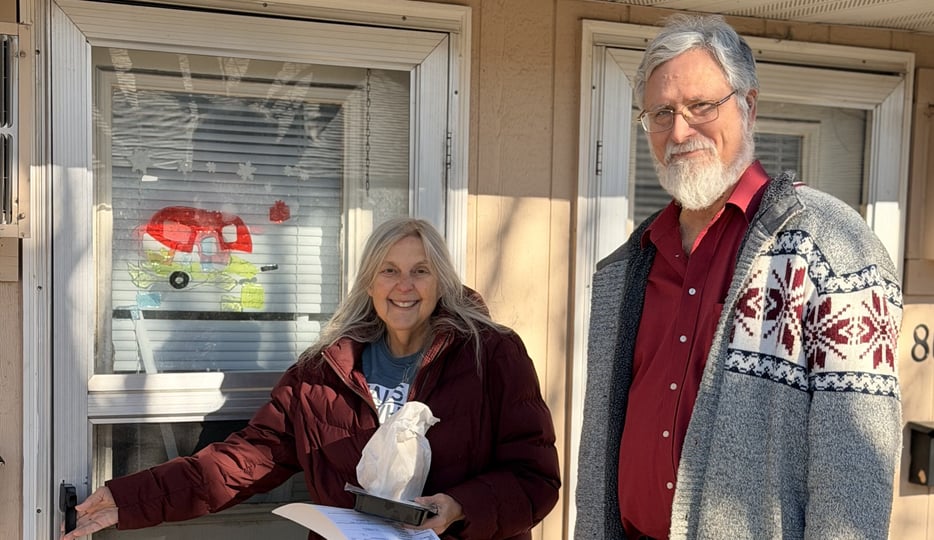
Tom and Linda Corson stepped forward.
“We knew people needed help,” Tom says. “We were retired, just sitting here. We were inspired, and we felt a sense of obligation. We had the time to give, and the ability to give.”
As WesleyLife Meals on Wheels volunteers, the Corsons quickly learned that what had begun as a response to a growing need would turn into something more enduring. Since 2020, the Corsons, who live in the Des Moines area, have delivered more than 4,000 meals to Central Iowans experiencing food insecurity, showing up week after week with consistency and care.
Forming connections
Early on, Tom and Linda were assigned a route and encouraged to get to know the people they served. Over time, their route became more than a set of stops; it transformed into a series of relationships.
“We serve the same people each week, which lets us know and come to care very much about them,” Tom says. “It’s more than handing someone a meal.”
That familiarity brings reassurance to Meals on Wheels clients who know the familiar knock at the door signals not just sustenance, but recognition and connection.
The consistency matters, especially for those who are isolated or without nearby family.
“Many of the people we see are alone in every sense of the word," Linda says. "As human beings, we need those connections, and some of them just don't have them. So the connections form perhaps a little quicker than they would in other circumstances, and they last.
"Even when clients no longer take our meals, we see them in the halls of their apartment or in their yards and they still say hello. There is still that level of connection."
As Tom and Linda have become so familiar with the individuals on their route, they've gotten to know the clients' family members as well, allowing different levels of connection to form.
“The families are so friendly and appreciative,” Tom says. “There’s a couple in their 90s — they have had health issues and they are fragile, but they come to the door and they are eager to see us. They are the sweetest people. Seeing them and knowing they are OK every day is a gratifying thing for us.”
Impact extends beyond meal delivery
When a need emerged to better support clients with pets, Tom and Linda stepped in again, helping to coordinate pet-food donations provided by Pet Project Midwest.
“Meals on Wheels knew of our love for animals, and they asked if we could help coordinate that,” Linda says.
What began as a small effort has grown into a reliable, well-coordinated system, thanks in part to the Corsons' leadership and persistence in refining the process.
“The way it’s developed is so much easier now,” Tom says. “We get a report of who among the clients has pets and what they need for them. Every Wednesday at 7 a.m., we check every name against that day’s list and make sure the lists and instructions and amounts are correct."
Equipped with pet food, Meals on Wheels drivers deliver it alongside client meals, ensuring anyone who needs it receives a week’s worth of support for their animals.
“I still can’t believe we help pets as well,” Linda says. “Because of the isolation, pets mean even more to the people we see. They love those animals and want to take the best care of them that they can. It warms my heart."
The program has expanded to include not just dogs and cats, but small animals as well, Tom notes.
“Birds, guinea pigs — all of it,” he adds.
For the Corsons, this work addresses a simple but powerful reality: No one should have to choose between feeding themselves and caring for a companion.
“It’s a plus that they don’t have to share their meals with their pet; that's what had been going on with so many of our people, and it's heartbreaking,” Linda says.
"We just wanted to help"
Tom and Linda are quick to downplay the importance of their roles, insisting that they themselves are "the lucky ones" to be able to volunteer.
“It’s not a difficult job if you’re a people person,” Linda says. “But even if you’re not, there is still a need for you to be there. People welcome the opportunity to have someone to talk to.”
What keeps them coming back is simple.
“The team is always so inclusive, even though we’re volunteers,” Tom says. “We just wanted to help, and we know we are needed. That's meaningful.”
There is something deeper, too; they recognize what their effort represents.
“It just makes me feel good that we are helping these people,” Linda says. “We’re not their age yet, but we will be someday, if we're lucky, and we hope someone will do the same for us.”